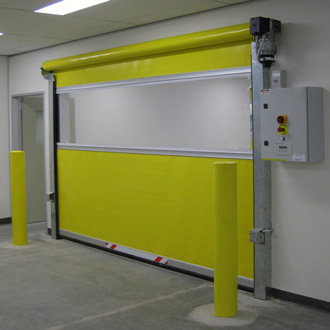
Warehouse efficiency runs deeper than floor space or headcount. The doors, often treated as an afterthought, directly influence throughput, energy consumption, and day-to-day safety. High-speed industrial doors have held a firm place in logistics and manufacturing for decades.
With equipment budgets tightening, facility managers are right to question whether the cost is still justified. Based on operational data and long-term cost patterns, the cost of high-speed industrial doors does still justify itself, and the reasons for this carry more weight than most people expect.
Energy Costs Are a Real Driver
Standard roller doors stay open far longer during active operations. Every extra second of exposure allows conditioned air to escape, and that loss compounds quickly across hundreds of daily cycles. Facilities handling climate-sensitive inventory feel the biggest hit.
High-speed doors close in seconds, not minutes. That difference cuts thermal exchange considerably, which shows up directly in heating and cooling bills. In large warehouses running year-round, the energy savings alone can recover a significant share of the installation cost over time.
Temperature-Controlled Environments
These pressures hit cold storage and food-grade facilities the hardest. Frequent door cycles put constant pressure on refrigeration systems, and every degree of temperature fluctuation adds up. Faster closure reduces that load, helping the internal environment stay stable without pushing equipment harder than necessary.
How Speed Affects Workflow
Forklift and pallet traffic through bays creates natural bottlenecks, and a slow door compounds that problem. Operators pause, idle, or reroute around the delay. Across a full shift, those small interruptions stack into something harder to ignore.
Facilities running high-speed doors report measurable improvements in cycle time. The door reads a sensor trigger, opens fully within seconds, and closes again before the next load arrives. That sequence keeps traffic moving without manual input or drawn-out wait periods between loads.
Integration with Automated Systems
Warehouses relying on conveyor systems, automated guided vehicles, or warehouse management software need their physical infrastructure to keep pace. High-speed doors can sync with these systems through sensor and control interfaces, aligning each door cycle with equipment movement. That eliminates one more friction point from an otherwise automated operation.
Safety Considerations
A slow-moving door creates a prolonged exposure window where vehicles and pedestrians share the same access point. High-speed operation shortens that window and reduces the overlap between foot traffic and active machinery.
Most high-speed industrial doors include obstruction detection, safety reversals, and vision panels as standard features. These prevent collisions and give operators a clear sightline before moving through. Fewer incidents translate directly to less downtime, lower insurance exposure, and a work environment that staff can rely on.
Maintenance and Longevity
A reasonable concern is whether high-speed mechanisms wear out faster than conventional options. The honest answer depends on design and cycle volume, but doors built for industrial use are engineered to handle high-frequency operation without rapid deterioration.
Many models use flexible curtain materials rather than rigid panels. These absorb minor impacts more effectively and tend to be straightforward to repair when something does go wrong. Austcold Industries supplies doors built for demanding environments where consistent performance and durability are baseline requirements, not optional upgrades.
Total Cost of Ownership
Purchase price is only the starting figure. Energy savings, reduced strain on climate systems, fewer accident-related costs, and better throughput all factor into the real number. Viewed across a three-to-five year horizon, high-speed doors frequently outperform cheaper, slower alternatives by a meaningful margin. Facilities running two or three shifts per day tend to reach that payback point faster.
What the Data Suggests
Industry benchmarks indicate that high-speed doors reduce door-related energy loss by 30 to 80 percent compared to standard sectional doors. The range reflects differences in door size, cycle frequency, and a facility’s thermal profile, but even the lower end of that figure represents real savings.
In high-volume operations, the door can recover its cost within two to four years. Add safety improvements and workflow gains into the calculation, and the return extends well beyond a single line on an energy bill.
Conclusion
High-speed industrial doors remain one of the more defensible capital investments a warehouse operation can make. The gains are measurable across energy performance, safety outcomes, workflow continuity, and long-term maintenance costs. Facility managers reviewing equipment upgrades should treat door speed as a functional variable with a direct bearing on the bottom line. In environments where margins are tight and operations run continuously, every second of unnecessary delay and every degree of temperature lost carries a cost worth taking seriously.