By Michael Gold
Grandma and Grandpa Jones are running up our national credit card bill. And there are more of them every day.
I recently took a look at why our Federal debt is so high. Social Security and Medicare costs are two of the major drivers of our increasing budget deficits.
Paying interest on the Federal debt is the third.
The number of people aged 65 and older is growing, as the Baby Boomers have retired, or will soon. In 2025, seniors were almost 19 percent of the American population. By 2035, they’ll be almost 22 percent of the country, according to the Peterson Foundation, an organization dedicated to helping put America on a sustainable fiscal path. It was founded by Pete Peterson, former Secretary of Commerce in the Nixon Administration and chairman of the New York Federal Reserve Bank from 2000 to 2004.
The other end of this problem is that women are having fewer children. It’s no wonder why. Raising a child is expensive, particularly when the Federal government is spending far more on seniors than kids.
“For every $1 it spends on a child, the federal government spends $6 or more on a retiree, despite the child poverty rate being more than double the senior poverty rate,” writes Maya McGuiness, president of The Committee For A Responsible Federal Budget (CRFB), another prominent fiscal watchdog.
Social Security spending is 22 percent of the Federal budget, more than any other category. Medicare is 14 percent and Medicaid is 10 percent. In comparison, the defense budget is 13 percent.
The Social Security and Medicare trust funds are on target to become depleted in 2033, the Peterson Foundation states. That’s when the fun will really begin. Either the government will have to cut benefits or figure out a way to raise revenues to pay for seniors’ monthly checks. In my brightest of hopes, Congress and the President will figure out a way to engineer a decent solution in a rational way. That sentence almost made me laugh.
The Social Security and Medicare tax on income in 2026 tops out at $184,500, according to the Social Security Administration (SSA). The SSA raises the taxable income limit every year to “keep pace with increases in average wages,” it states on its website.
It would make sense to designate a much higher ceiling on taxable income to pay for Social Security and Medicare. Why should people who make fabulous amounts of money get a free ride on income they earn over $184,5000, while everyone else dutifully pays their usual 7.65 percent on each paycheck, along with their employer? We have here a profound issue of fairness in terms of bearing the burden, in which the middle class and working poor usually lose out.
In terms of defense, 13 percent of the budget, is it too much to ask that our lawmakers start looking critically at how we spend the money for our weapons and warships? For example, both Ukraine and Iran have demonstrated that building and deploying drones is far less expensive and often more effective than tanks and planes in wartime? Of course, we need all these things, but maybe we can balance it out more evenly, by allocating more to drones than battleships?
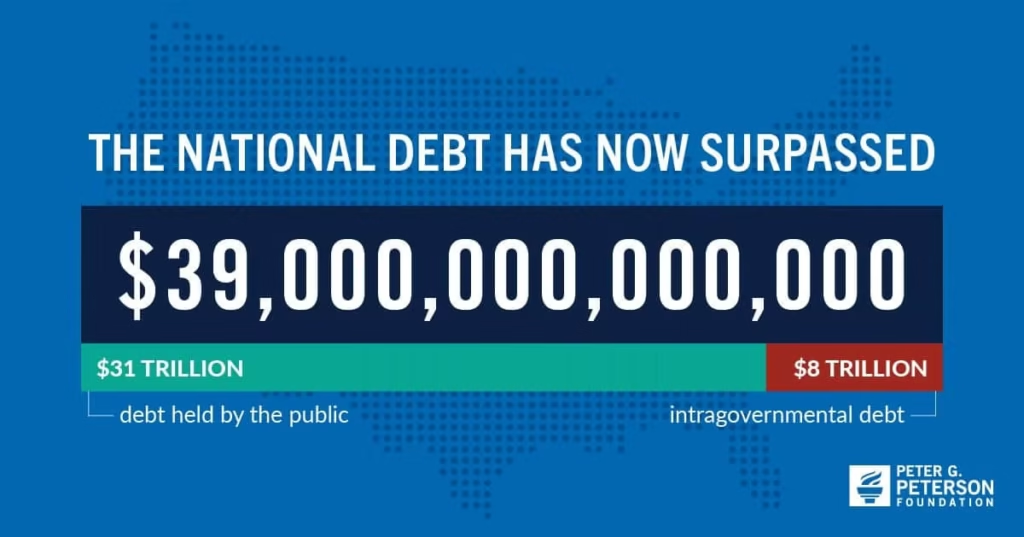
The interest on the debt is currently 14 percent of the Federal budget and growing. This is shameful and dangerous. The nation’s debt is currently $39 trillion.
As the Peterson Foundation points out, the massive debt the U.S. government holds crowds out private investment, which could be used by the private sector, to invest in researching and creating new innovative products to help benefit public health and material gains and grow our economy.
The other problem is that someone has to pay off this debt. By borrowing increasing amounts of money to fund the government, we are tossing the debt load to our children, grandchildren and future generations, so they can pay it off, which is horribly irresponsible.
Good parents try to teach our children to save money, in order to plan for the future. Because the future always comes. I remember in that ancient movie, Saturday Night Fever, John Travolta’s character says, “Forget the future!” (He used a much stronger word than forget.) His employer told him that’s wrong, that the future doesn’t forget you – it does something much worse to you (Again, a much stronger word was used in the dialogue.).
What we’re doing right now is what Travolta’s character in the movie wanted to do. We are forgetting the future.
What is the message we are sending to the younger generations when we let the Federal government spend so carelessly? Seniors are having a very long, drunken party at the expense of our children and grandchildren. We’re giving young Americans, our descendants, a very poor education in managing money and being responsible.
The funding shortfalls in both Social Security and Medicare are a problem that will almost certainly fester until the situation becomes a real emergency.
New York City came right to the edge of the cliff of bankruptcy in the 1970s before it was saved by a complete reorganization of the city’s finances, under the authority of New York State.
The state’s Municipal Assistance Corporation (MAC) froze city employees’ wages, laid off municipal workers, raised subway fares and directed the city to start charging students to pay tuition at all City University colleges, among other moves.
The Federal government is much bigger than New York City was in 1975. Our debt stands at $39 trillion. When I first wrote a column about this in January, the debt was $38 trillion. We’ve run through $1 trillion in new debt in four months.
I recently saw a movie on Netflix, called Send Help. The main character, played by Rachel McAdams said at the end, “No help is coming, so you’d better start saving yourself.”
There is no Superman or giant bank in the sky that will solve our breathtakingly awful debt. We need to do it ourselves.
Part of the problem is that our lawmakers are not even talking about this stuff. Somebody with a profile bigger than the Peterson Foundation and the CFRB needs to start a conversation about how we’re going to get out from under this debt boulder under which we’re trapped.
We’ve got to somehow break through all the media clutter and get our representatives to pay attention. We need to start paying for this party.
Michael Gold is a Westchester based reporter whose work has been published in The New York Daily News, The Albany Times-Union, The Hartford Courant and other newspapers. He’s a volunteer trustee with the Putnam County Land Trust.