

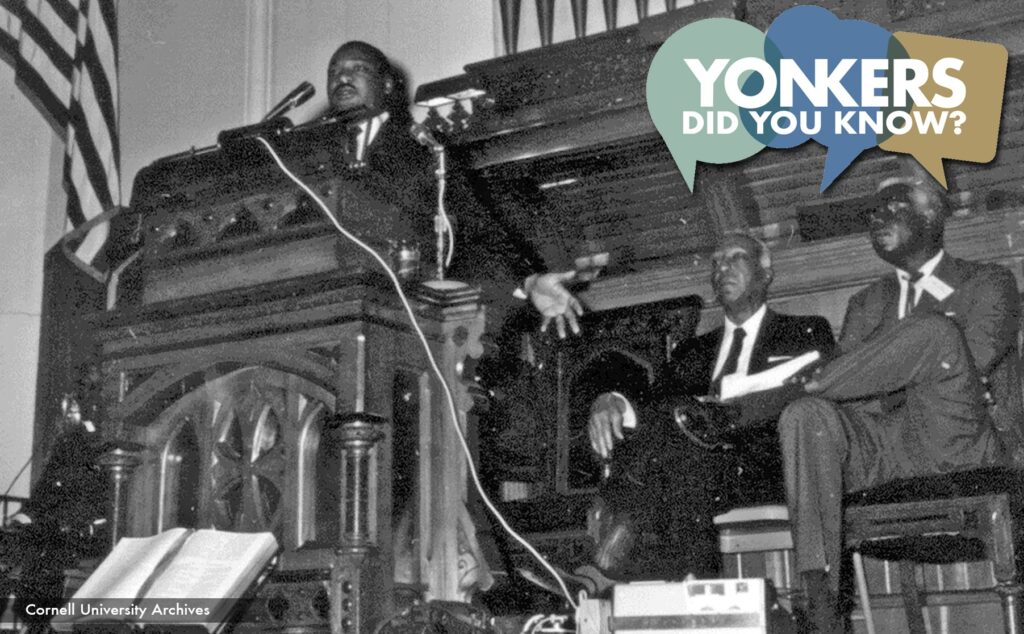
Dr. Martin Luther King, Jr., speaks during a public rally at Messiah Baptist Church in Yonkers on May 28, 1965. Seated are A. Philip Randolph and Joseph T. Jackson, President of the Westchester NALC chapter. Photo courtesy of Cornell Labor Relations Collection)
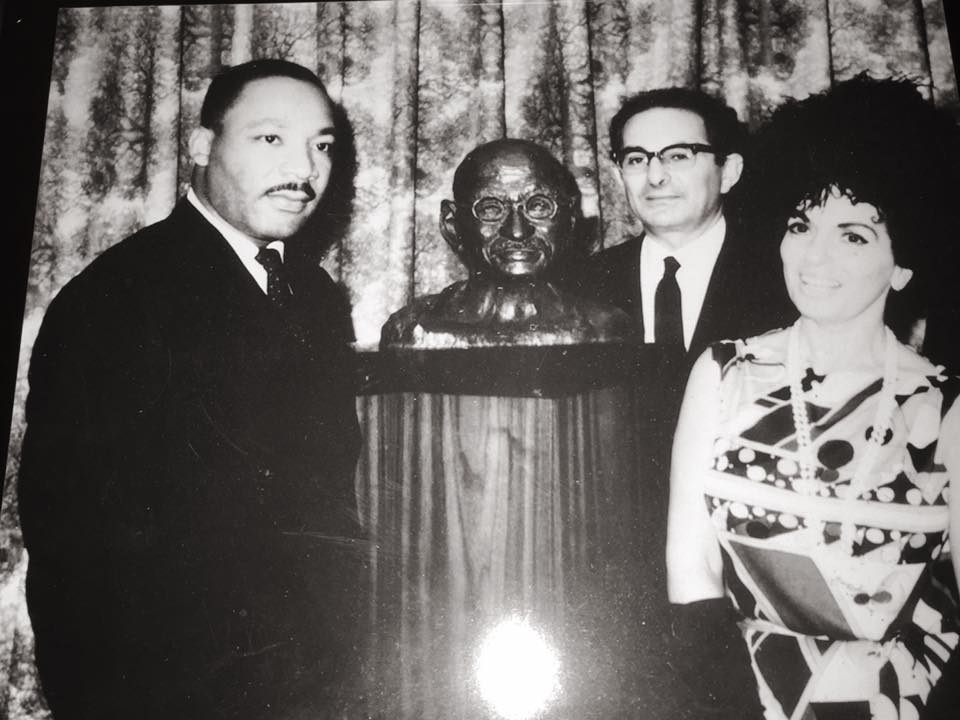
Dr. Martin Luther King Jr., stands beside a bust of Mahatma Ghandi at an arts festival at Temple Emanu-El in Yonkers, May 28, 1965. With King are Rabbi Abraham Klausner and Yetta Colin, sculptor of the bust. Photo courtesy of Scarsdale Synagogue Temples Tremont and Emanu-El.
By Dan Murphy
Dr. Martin Luther King Jr. visited Westchester on 12 occasions over an 11-year period (1956-1967), before his life was cut short on April 4, 1968, at the age of 39. In 2007, a memorial was erected in front of the county office building in White Plains to honor his life and time spent in Westchester. Dr. King’s birthday on January 15, 1929, was made a federal holiday in 1983.
One of the best summaries about Dr. King’s visits to Westchester was written by Andy Bass for the Westchester County Historical Society in 2018. A special edition of the Westchester Historian, the society’s quarterly magazine, features Bass’s lengthy, detailed, and interesting piece. We encourage our readers, and lovers of Westchester history or MLK Jr., to purchase this magazine and read Bass’s piece, available at the Westchester Historical Society’s office in Elmsford for $10. This story is not online. We thank Bass for his historical masterpiece and use it as a reference for our story about King’s Westchester visits for our readers.
Included in King’s 12 visits were two stops in Yonkers. In 2023, Bass was interviewed by Yonkers City Hall TV to discuss Dr. King’s visits to Yonkers. He wrote and shared this summary:
AUGUST 27, 1964
Dr. Martin Luther King, Jr. first visited Yonkers on August 27, 1964, to participate in a press conference announcing the upcoming release of a compendium of books on black history of which he had contributed a volume. At the time, King viewed the promotion of black history as “the next frontier in [the civil rights] struggle.”
The collection of books titled, The Negro Heritage Library, were published by a small, new publishing company based in Yonkers called Educational Heritage, Incorporated. The company was founded by a Yonkers man by the name of Noel Marder. Earlier that year, King’s Chief of staff Wyatt Tee Walker had left his position as Executive Director of King’s Southern Christian Leadership Conference in Atlanta to join the Yonkers company as Vice-President in charge of marketing and services. Walker, along with his wife and four children, moved to Yonkers the month before the press conference after purchasing a home at 52 Delaware Road.
The press conference with King was held at Education Heritage’s headquarters in an office building at 733 Yonkers Avenue. The inaugural release of The Negro Heritage Library consisted of ten volumes, including King’s contribution, A Martin Luther King Treasury.
Perhaps the most interesting section of the King volume is the one titled “The Days of Martin Luther King: A Photographic Diary.” It features exclusive, behind-the-scenes photos of King at his Atlanta home and office that were taken by Educational Heritage’s staff photographer Roland Mitchell.
After the press conference, King visited the Sprain Brook Branch of the Yonkers Public Library (known today as the Will library) where the Urban League of Westchester was running a week-long voter registration drive. King was personally introduced to each of the registrars and he thanked them for the service they were performing.
Educational Heritage did not last long. Less than three years after launching The Negro Heritage Library, the company went bankrupt. The original ten volumes of the The Negro Heritage Library were the only books it ever published.
In his final correspondence with Marder, just 66 days before his assassination King wrote of The Negro Heritage Library:
“I still think those volumes are making a significant contribution to the life of young Negroes.”
Wyatt Tee Walker had left Educational Heritage a few months before its collapse, landing a position as interim pastor of Canaan Baptist Church in Harlem. The following year, Walker was ceremonially installed by King as the church’s senior pastor only ten days before his assassination.
Walker continued to live in his Delaware Road home, regularly commuting to the church. Over the next four decades he became a leading civic leader in Harlem. Walker retired as pastor in 2004 following a series of debilitating strokes and lived his remaining years in Virginia. At the time of their move in 2005, Walker and his wife had lived in Yonkers for 41 years.
MAY 28, 1965:
King’s second visit to Yonkers on May 28, 1965, was initiated by a speaking invitation he received from A. Philip Randolph, one of the most significant labor and civil rights leaders of the 20th century. Randolph’s group, the Negro American Labor Council, was holding its annual convention in Yonkers, and he implored King to come address the attendees.
Only weeks earlier, the Council’s Westchester branch had been involved in a contentious labor dispute at Lawrence Hospital in Bronxville on behalf of striking service and maintenance workers. The 55-day strike featured weekly demonstrations that culminated in a physical altercation with police. Likely in response to the dispute, the group elected to hold their annual convention just two miles west of the hospital at the Westchester Town House, a motor inn and dinner theatre at 165 Tuckahoe Road.
As Randolph was a revered figure amongst his civil rights peers, King readily accepted his invitation. On May 27, King spoke at two events organized by the Council. He first addressed convention attendees at a daytime session at the motel. Then that evening, he spoke to a gathering of 900 at a public education rally at Messiah Baptist Church on Warburton Avenue. The speech was noteworthy for including one of King’s earliest public pronouncements against the Vietnam War.
Following the church event, King made two final stops in Yonkers. The first was to St. Joseph Hospital to visit Noel Marder’s fiancée, Rita McLain of Educational Heritage, who was recovering from an illness. Afterwards, he went to Temple Emanu-El on Rumsey Road for a private viewing of an exhibit of painting and sculpture by African American artists. The exhibit was part of the Temple’s annual arts festival. The festival’s general chair, Yetta Colin, had created a bust of one of King’s role models, Mahatma Gandhi, that was also on display in the temple. Before departing, King posed for a photo alongside the Gandhi sculpture with Colin and temple leadership.

