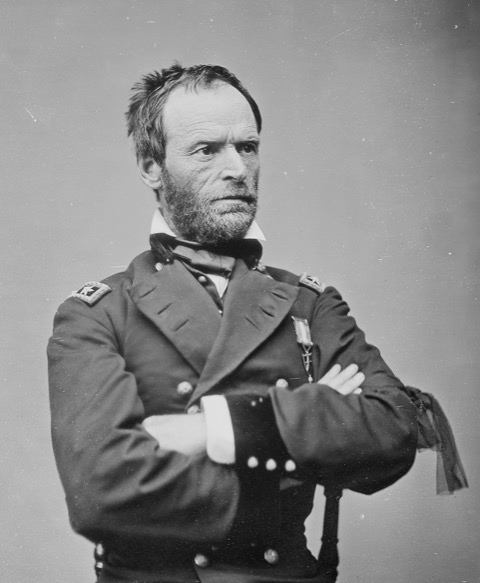
General William T. Sherman
By Mary Hoar, City of Yonkers Historian, President Emeritus Yonkers Historical Society, recipient of the 2004 Key to History, Yonkers Landmarks Preservation Board Member, Chair of Revolutionary Yonkers 250 and President Untermyer Performing Arts Council
Monday, October 20th
October 20, 1776: Chief Engineer of the Continental Army Rufus Putnam rode through Yonkers and passed by the Manor Hall and Sherwood House on his way to pass information on to General Washington and General William Stirling.
October 20, 1943: Norah Maher of St. Joseph Avenue received a letter from Senator James Mead of New York, telling her he had met her son Howard, and he was happy and in good health. Private Maher had been on duty with a Military Police unit in North Africa, when a car with visiting government officials pulled up. After a few moments of polite conversation, Mead asked Maher where he was from, and upon hearing Yonkers, the Senator asked if he knew Eddie Murray (City and County Democratic Chairman Edward J. Murray) and Bill Cronin (Postmaster William Cronin). At the end of the conversation, Maher asked the senator to call his mom in Yonkers and let her know he was doing fine.
Maher was a St. Mary’s and Yonkers High graduate.
Tuesday, October 21st
October 21, 1776: Washington established headquarters at Thomas Valentine’s home on Valentine’s Hill; while there, General Benjamin Lincoln joined him.
October 21, 1944: Charles Rugg, Counsel for Rear Admiral Husband Kimmel of Bronxville Road, branded Navy Secretary James Forrestal’s statement the Pearl Harbor disaster report was “Top Secret,” and could not be made available as a “specious pretext to keep the truth of Pearl Harbor hidden.” Rugg stated the secrecy was unjust to Kimmel, who was entitled to hear the court verdict. Kimmel was the Commander at Pearl Harbor at the time of the Japanese attack.
Minnesota Congressman Melvin Mass, ranking member of the House Naval Affairs Committee, criticized Forrestal’s decision, stating, “There is no element of military security involved in this matter.” And continued the only reason it wasn’t made public was it was “politically embarrassing to the Roosevelt Administration.”
Wednesday, October 22nd
October 22, 1913: A metal plaque, made from the hull of the ill-fated battleship U. S. S. Maine, was presented to Wallace F. Randolph Camp 27, United Spanish War Veterans.
October 22, 1919: The K of C Memorial Hut Drive passed the $55,000 mark. The front page headline on The Yonkers Herald read, “The Disabled Soldiers at the Trades’ School Have Shown by Their Contributions Why Every One Should Aid the K of C Memorial Hut Fund.” They ran this headline several days.
October 22, 1942: Responding to an appeal by Father Arthur Avard, pastor of the Church of the Immaculate Conception (St. Mary’s), owners of plots in St. Mary’s Cemetery donated more than 2½ tons of plot railings to the war effort. L. J. Proft, Superintendent of the cemetery on Sprain Road, added that in one section, he did not need consent to remove the railings, and estimated that would contribute an additional seven tons of metal.
Thursday, October 23rd
October 23, 1779: An ordinance was passed to provide temporary government for the Yonkers area until the enemy was dispossessed of the area.
October 23, 1890: General Thomas Ewing held a reception in his home on High Street to honor war hero and one of the most renowned Civil War military leaders, William Tecumseh Sherman. After the death of his father in 1829, the Sherman family was broken up. The family of Senator Thomas Ewing of Ohio took in William Sherman and raised him. Ewing, the first Secretary of the Interior, obtained a commission to the United States Military Academy for Sherman, and stood up as godfather when Sherman converted to Catholicism, holding the baptism in the Ewing family home. Sherman married Eleanor “Ellen” Ewing in 1850.
October 23, 1976: Bobby Hackett of Yonkers slashed almost 40 seconds off the 1,500-meter men’s free style swimming record.
Friday, October 24th
October 24, 1941: The US Army sent 40 trucks to Larkin Plaza to pick up more than 1,000,000 pounds of precious scrap metal collected from homes and stores of patriotic Yonkers residents. The metal had been stored near the Nepperhan Avenue City Garage.
October 24, 1945: Acting Public Safety Commissioner Francis Duffy put a new regulation into effect; any police officer who damaged his uniform in the line of duty would be reimbursed for the cost of repair. This was good news for the officers, especially the new members of the force who had not reached full salary.
Saturday, October 25th
October 25, 1903: The Board of Park Commissioners directed the department’s staff to prepare to plan two dogwood trees and one rare sassafras tree in Manor Hall Park.
October 25, 1924: A tip that 80 revolvers had been shipped to Yonkers from Philadelphia led to a raid on a building at 8 Herriot Street by a combined force of Yonkers police and New York City detectives. Bullets discovered at the scene matched those found at a Corona murder scene. They arrested the suspected murderer and 25 other people involved in a plot to hide Hip Sing tong gunmen in Yonkers. The day before the raid, four members of the gang patrolled the street while visitors went to the address, and two additional guards were placed at the corner of New Main and Herriot, a block away from their headquarters. Police believed high officials of the Hip Sing tong had visited the day before the raid.
October 25, 1946: Manager of the Tercentennial Office Ted Worner had asked all our waterfront industries to welcome the destroyers Fochteler and Isbell with their factory whistles and sirens to welcome the ships coming to celebrate Navy Day. No sound other than the cheers from hundreds of people along our waterfront as the sleek vessels neared the Recreation pier reached his ears, and he worried they had forgotten. Suddenly one loud whistle sounded… then another… and then more.
Sunday, October 26th
October 26, 1776: American light horse and infantry companies took overnight possession of the Manor Hall on their way to the Battle of White Plains.
October 26, 1935: Socialist Mayoral candidate Otto Riegelman challenged his opponents, Democratic Mayor Joseph Loehr and Republican John Condon to publicly debate whether Yonkers should have a municipal light and power plant.
Questions or comments on this column? Email YonkersHistory1646@gmail.com.
For information on the Yonkers Historical Society, Sherwood House and upcoming events, please visit our website www.yonkershistoricalsociety.org, call 914-961-8940 or email info@yonkershistoricalsociety.org.