
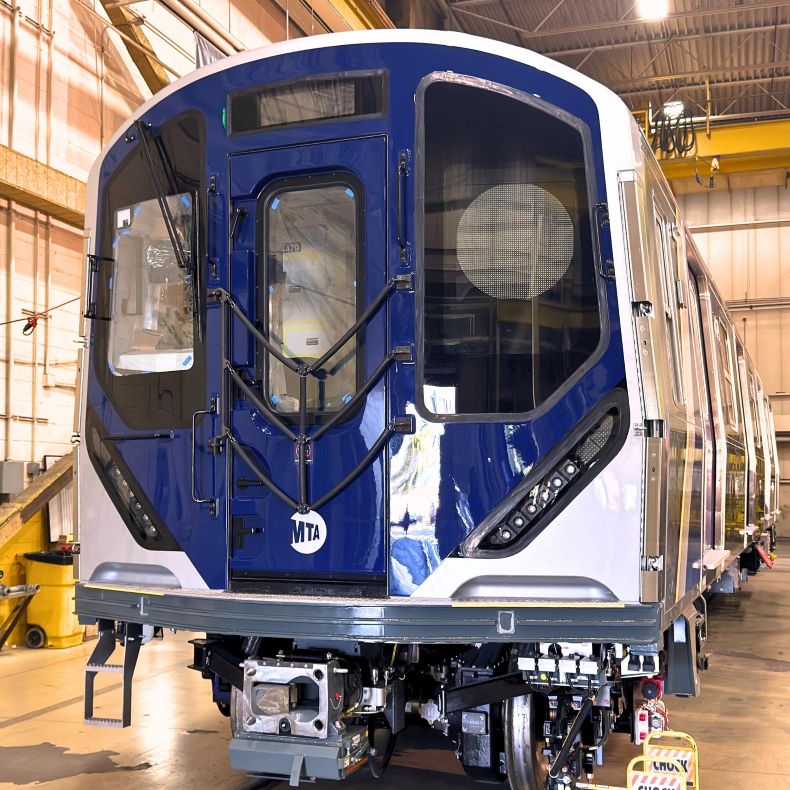
A newly released report from Jobs to Move America and Cornell University’s Climate Jobs Institute reveals troubling findings about working conditions at MTA contractor Kawasaki’s railcar manufacturing facilities in New York and Nebraska.
Citing low pay, hazardous conditions and widespread experience of discrimination reported by workers, a coalition of NY and Nebraska groups are calling on Kawasaki to begin negotiating a legally binding Community Benefits Agreement (CBA) that would ensure the public monies the company receives are matched by fair treatment for its workers and neighbors.
Kawasaki has received billions of dollars over the past four decades to manufacture railcars for the MTA. In 2018, the NY MTA awarded the company a $4.5 billion railcar contract – the largest in its history.
Although Kawasaki committed to providing good jobs for the duration of the contract, specific details about wages and benefits have been withheld from the public by the MTA, citing the company’s concerns that such information may “unnecessarily agitate” its workforce.
In the absence of this data, report authors spent a year surveying 180 Kawasaki workers and conducted in-depth interviews with current and former workers to independently assess working conditions at the company’s manufacturing facilities in Nebraska and New York.
Many described a culture that prioritizes speed and profit over safety and well-being, contributing to low morale and serious injuries.
Key findings from the report
Pay Inequities
- Surveyed women earned $3.49 less per hour on average than surveyed men.
- Temporary workers hired through staffing agencies represented over half of survey respondents and earned $4.66 less per hour on average than workers directly hired through Kawasaki.
Unsafe Working Conditions
- Workers reported witnessing a coworker get injured (40%) or being injured themselves (17%) at their worksite.
Widespread Experience of Discrimination
- Half of workers reported witnessing unfair treatment based on race (24%), gender (24%), immigration status (10%), and other protected categories.
Toxic Workplace Culture
- Workers reported witnessing supervisors use slurs or derogatory language about a group of people (16%) and make offensive comments or jokes (27%) in the workplace.
“Kawasaki has benefited from billions in public contracts while the very workers who build the trains for our transit systems struggle with low wages, dangerous conditions, and disrespect on the job. Our union stands with these community leaders to demand accountability. If the MTA changed course and became a positive force in this equation, workers in New York and Nebraska could win the safe, stable, and family-supporting jobs they deserve.” – John Samuelsen, International President, Transport Workers Union
“We applaud investments to keep New York’s world class transit system at 21st century standards, but only if those standards include dignified, safe, family-sustaining jobs for working families. We urge the MTA to do everything in its power to hold the companies building our rail cars – Kawasaki and any others awarded contracts in the coming years – accountable to values of respect, transparency and fair wages in treatment of their workers.”
Theodore A. Moore, ALIGN Executive Director.
“Our congregation and community are proud to host the makers of New York’s famous subway cars, but we’re also shocked by Kawasaki workers sharing their experiences with below-average wages, temp labor, race and gender discrimination, and injuries on the job. Yonkers residents insist on good, career-track jobs for our people, and we’re eager to partner with Kawasaki to turn it into a model, high-road employer.” – Rev. Margaret Coleman, Messiah Baptist Church of Yonkers
Read the report at file:///C:/Users/djmya/Downloads/JMA_Report-v4-digital-FINAL.pdf
Editor’s Note: We received the following statement from a spokesman for Kawasaki. “Kawasaki is proud to be a leading employer in the communities we serve, offering good jobs with competitive wages and full benefits. The well-being of our employees is a priority and our workplace environments are safe, clean and organized. Our commitment to our very diverse workforce has fostered a strong and loyal team that consistently delivers best-in-class rail cars at fair prices for our customers.
“We are always looking for ways to improve our operations. However, the recent survey promoted by the JMA provides little meaningful insight into our Kawasaki facilities — a fact even acknowledged by its own authors. This effort appears to be driven by an organization with a clear agenda, one that our employees have repeatedly rejected in the past. We trust our workforce to see through these tactics and remain confident they will continue to stand with us in both Nebraska and New York.” end of statement.
Kawasaki also underscored this piece from the report. METHODOLOGY: To evaluate working conditions at Kawasaki’s U.S. railcar production facilities, researchers from Jobs to Move America and the Climate Jobs Institute at Cornell University conducted a survey and in-depth interviews between May 2024 and May 2025. A total of 180 workers from both locations participated in the survey. Due to differences in facility sizes – 2,700 workers in Nebraska compared to 400 in New York – the Nebraska facility accounted for 139 respondents (77%), while 41 respondents (23%) came from the New York facility. Given the small size of the New York sample, these results are not considered representative or generalizable for that location.