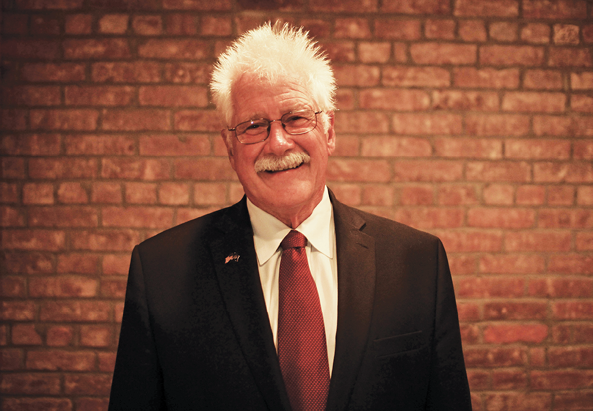
Larry Wilson
By Dan Murphy
For nearly 20 years, Empire City Casino has stood as Yonkers’ largest private employer and taxpayer, supporting hundreds of jobs and generating more than $5 billion for the New York State education fund. Now, as the casino seeks one of three full commercial casino licenses that New York State will award this year, a local community group is organizing efforts to block the expansion, despite clear warnings from city officials that losing out would devastate Yonkers’ finances.
The Hyatt Community Association, a neighborhood group representing residents off Kimball Avenue, has long opposed the casino’s growth. Led by Larry Wilson, the group has taken a prominent role in mobilizing opposition. In a move many see as a glaring conflict of interest, Senate Majority Leader Andrea Stewart-Cousins appointed Wilson, Empire City’s most outspoken critic, to represent her on the Community Advisory Council (CAC), the very body charged with gauging community support.
Hyatt Community Association members received an email on Thursday, sent through the association’s official account but closed with the name Vice President Jerry Longarzo instead of Wilson, urging residents to oppose the project. The email warned: “If you allow it to pollute the quality of life in our neighborhood for 24 hours every day for the rest of our lives!!!!”, urging neighbors to preface remarks at the upcoming CAC hearing with “I oppose because…” The message also provided scripted talking points and directed residents to immediately send written opposition to the state.
The email contained no mention of jobs, revenues, or schools, only exclamation points and panic. Critics blasted it as blatant fear-mongering, designed to scare residents rather than inform them.
High Stakes for Yonkers
The stakes are substantial. Empire City’s license application is the only one outside of New York City, with seven competitors concentrated in the five boroughs. Without a license, Empire City would be unable to compete against three new full-scale casinos and would likely face closure, a fact that Empire City President Louis Theros confirmed during previous CAC meetings. A state-commissioned casino market study also confirmed that trajectory. That would leave Yonkers not only without its largest private employer, but also without a critical source of future tax revenue.
Former Deputy Mayor Jim Cavanaugh underscored the urgency during a CAC meeting earlier in August, suggesting residents could face property tax increases of up to 13% without the revenues from a commercial casino license at Empire City.
Yonkers faces a recurring school budget deficit of up to $70 million, with local schools in urgent need of repair or replacement. Already saddled with a city income tax and hit with a 6% property tax hike last year, Yonkers residents have little room left to give, and the City has no other source of revenue. Without the $56 million in new annual revenue projected in year one of a full license, Yonkers taxpayers will be forced to fill that gap. With New York State facing a $3 billion budget deficit next year and $37 billion by 2029, according to State Comptroller reports, the state will not be swooping in to save Yonkers..
Jobs and Economic Growth
Empire City currently employs 745 workers and eighty percent of the workforce is union-represented. This license would allow MGM Resorts to add 2,000 permanent jobs with an average compensation package of $150,000, as well as 6,500 construction jobs generating approximately 4 million work hours.
The ripple effect is expected to be even greater. Analysts project thousands of additional indirect and induced jobs spurred by the $1 billion in new annual economic activity, as well as expanded vendor spending and supply chain impacts by the casino.
Financial Commitments
Under the proposal, Empire City’s annual gross gaming revenue is projected to rise to $1.1 billion. With a license, MGM would be required to contribute roughly $450 million annually — including $315 million to the state’s education fund, $68 million in revenue share for Yonkers and local counties, and $70 million for horse racing purses and breeders.
Yonkers alone is expected to receive $34 million in direct revenue share and an additional $22 million in property, sales, and wage tax revenues, for a total of $56 million in year one. Westchester County would benefit from $17 million, while Rockland and Putnam counties would share another $17 million.
Speed and Location Advantage
Unlike its competitors, Empire City can move quickly and the project is shovel-ready. Renovations of 282,100 square feet of existing space will include the casino, food and beverage venues, a dealer school, and administrative offices. MGM plans 360,000 square feet of new construction, including three new restaurants, a 5,000-capacity entertainment venue, and event spaces. The casino would remain open during construction, ensuring continued revenue to the state. It would transition to operating as a commercial casino within 9–12 months, while entertainment venue construction would take 36 months.
Supporters argue that no other location can recapture the billions New Yorkers currently spend at casinos in New Jersey, Pennsylvania, and Connecticut as effectively as Yonkers, given its position at the intersection of major commuter routes and its proximity to nearly 70 million tourists passing through New York City each year.
A Divisive Debate
Despite these arguments, opposition led by Wilson through the Hyatt Community Association is intensifying. The email framed as from Longarzo cites quality-of-life concerns for nearby residents. Supporters dismiss these claims as recycled fear tactics and point to Empire City’s nearly 20-year track record as a responsible employer, taxpayer, and community partner. No alternative revenue solutions have been presented by Wilson or Longarzo for the city’s looming fiscal challenges.
The decision now rests with the Community Advisory Council, which will hold its second and final public hearing on Tuesday, September 16, at 6 p.m. at Yonkers Montessori Academy, 160 Woodlawn Avenue.
With jobs, schools, taxes, and Yonkers’ economic future on the line, the battle over Empire City’s expansion has become a test of whether community voices, both for and against, can shape the city’s path forward. If Wilson continues leading a campaign of misinformation instead of constructive dialogue, he could single-handedly sabotage the largest taxpayer and private employer in New York’s third-largest city. And if that happens, it won’t just be Empire City that loses; it will be every Yonkers resident.