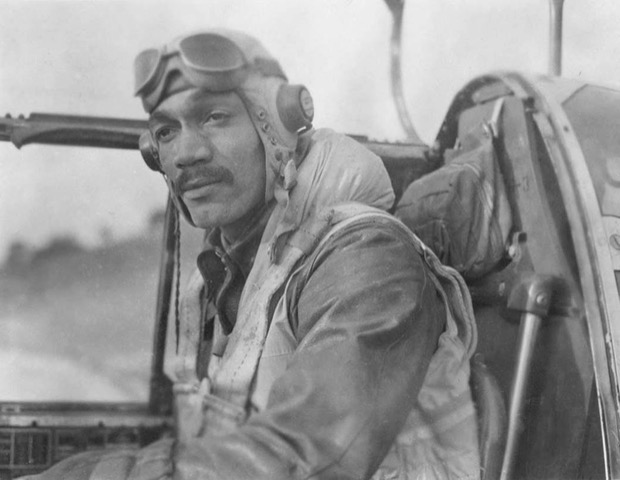
Tuskegee Airman Lee Archer, Jr, born in Yonkers
By Mary Hoar, City of Yonkers Historian, President Emeritus Yonkers Historical Society, recipient of the 2004 Key to History, Yonkers Landmarks Preservation Board Member, Chair of Revolutionary Yonkers 250 and President Untermyer Performing Arts Council
Monday, September 1st
September 1, 1943: Yonkers war plants announced they would be open for business on Labor Day… like every other day! Otis operated on its usual schedule; Smith Carpet Company ran their machine shop. Cameo Curtains on John Street continued to manufacture fragmentation bomb parachutes, field bars and netting tents. Blair Shipyards worked 24 hours a day if a “ship was in” for repair, and it was! US Shipbuilding worked under the same circumstances. Warburton Avenue’s Becopa Glove Mills and other glove manufacturers dedicated themselves to fulfilling defense contracts as quickly as possible, as did American Dietaids Company on South Broadway, who made “Soluble Coffee Products,” packaged for the American Red Cross and sent to European and Asian prisoners of war.
September 1, 1943: The Yonkers War Council and the Office of Civilian Protection announced they would stand down for the remainder of 1943 unless the Common Council voted to add $16,551.60 to their budget. They needed flashlights for the Auxiliary Police, medical equipment for casualty stations, demolition squad equipment, blackout identification headlight masks, pennants for Defense Driving Corps and radio communication equipment.
Tuesday, September 2nd
September 2, 1944: Yonkers War Council’s Committee on Gardening for National Defense announced results of their extensive inspection and examination of Yonkers Victory Gardens.
First place went to R. Schneider of Rudolph Terrace, whose garden was cultivated on the Untermyer estate west of North Broadway. A. Johnson’s Wickes Avenue home garden ranked second. Both received high marks from judges led by William Crocker, Director of Boyce Thompson Institute for Plant Research; their gardens remained fully planted, extending their yield to Fall.
Winners of the “group gardens” awards were that of Messrs. Sieb and Kirchner, grown on the Untermyer estate west of North Broadway. Second place went to the garden of Messrs. Healy and Fix, grown on the Untermyer estate east of North Broadway.
Wednesday, September 3rd
September 3, 1918: Wallace Lodge, the new hotel founded by the Board of Foreign Missions of the Methodist Episcopal Church, officially opened at Highcliff Hall, formerly Park Hill girls’ day and boarding school in Park Hill. After a tour of the grounds, the Lodge held a reception for 150 guests. A gift to the church, it was used for conferences and accommodations for foreign and home missionaries.
September 3, 1938: Although a lifesaving crew rushed to the Ludlow Westchester Service Corporation dock to save a man struggling in the water, nineteen-year-old Joseph Daniel fished 35-year-old Kavin Gannon out of the Hudson. Gannon claimed to have fallen in the river while on the Dock; witnesses reported Gannon jumped into the Hudson. After being examined at St. Joseph’s Hospital, he was taken to the City Jail.
Thursday, September 4th
September 4, 1918: Colonel William Boyce Thompson created a local Westchester newspaper, the Home Paper, to send to Westchester soldiers and sailors, giving servicemembers “happiness keeping up with events at home.” Thompson formed an organization to bring his process elsewhere. The Home Paper garnered much praise, so the Colonel gave a dinner at the Union League Club for the members; members of the New York Press Association and others interested in creating a nationwide network of papers were invited.
Colonel Thompson became president and John Sleich of Leslie’s Weekly was named Vice President. The group created a national campaign under the direction of APA’s Courtland Smith: members were scattered from Ardsley to Indiana to Boston to Harrisburg. The campaign committee asked all newspapers in the country to send free “neighborly intercourse” directly to every serviceman newspaper in the US. They asked public cooperation as it was expensive to mail free local papers to our men in “foreign service.”
Friday, September 5th
September 5, 1920: Dr. Paul Bauerberg addressed the local Socialist Party open-air meeting at the corner of Guion and New Main Streets.
September 5, 1932: Captain of the 1929 Notre Dame undefeated Fighting Irish football team coached by Knute Rockne, and Manhattan College Coach Johnny Law began coaching football at Sing Sing Prison.
Saturday, September 6th
September 6, 1919: Future Tuskegee Airman Lee Archer, Jr., was born to May and Lee Archer Sr. at their Woodworth Avenue home.
As a child in Yonkers, Archer’s favorite pastime was reading comic books about World War I flyers!
After the family moved to New York City, Archer attended DeWitt Clinton High School and NYU. Archer flew 169 missions over 11 countries in “Ina The Macon Belle,” his red tail P51 Mustang named for his girlfriend and later wife, Ina Burdell.
The only Airman officially designated an Ace, to this day he remains the sole African American Ace.
After retirement from the military, Archer returned to Westchester and joined General Foods, serving as Vice President and chief executive of three of its investment companies.
Sunday, September 7th
September 7, 1939: Yonkers welcomed the Batory. flagship of the Bdynia-American Line to our fair city. It was the largest passenger liner ever to visit Yonkers.
Barred from returning to its homeport Gdynia on the Polish Baltic’s coast, Batory dropped anchor in the Hudson River near the City Pier, allegedly “awaiting orders.”
While off the pier, the ship received a telegram: “THE POLISH PEOPLE OF YONKERS GREET THE BATORY AND CAPTAIN BORKOWSKI TOGETHER WITH HIS GALLANT CREW.”
The crew disembarked at the Yonkers Canoe Club and enjoyed its hospitality. Later, they were entertained by members of the Polish Community Center.
While ashore, Captain Borkowski completed his immediate mission—finding a good glass of beer!
The Batory’s veil of secrecy intrigued Yonkers; thousands of our residents went to the waterfront to look at the ship.
Questions or comments on this column? Email YonkersHistory1646@gmail.com.
For information on the Yonkers Historical Society, Sherwood House and upcoming history events, please visit our website www.yonkershistoricalsociety.org, call 914-961-8940 or email info@yonkershistoricalsociety.org.