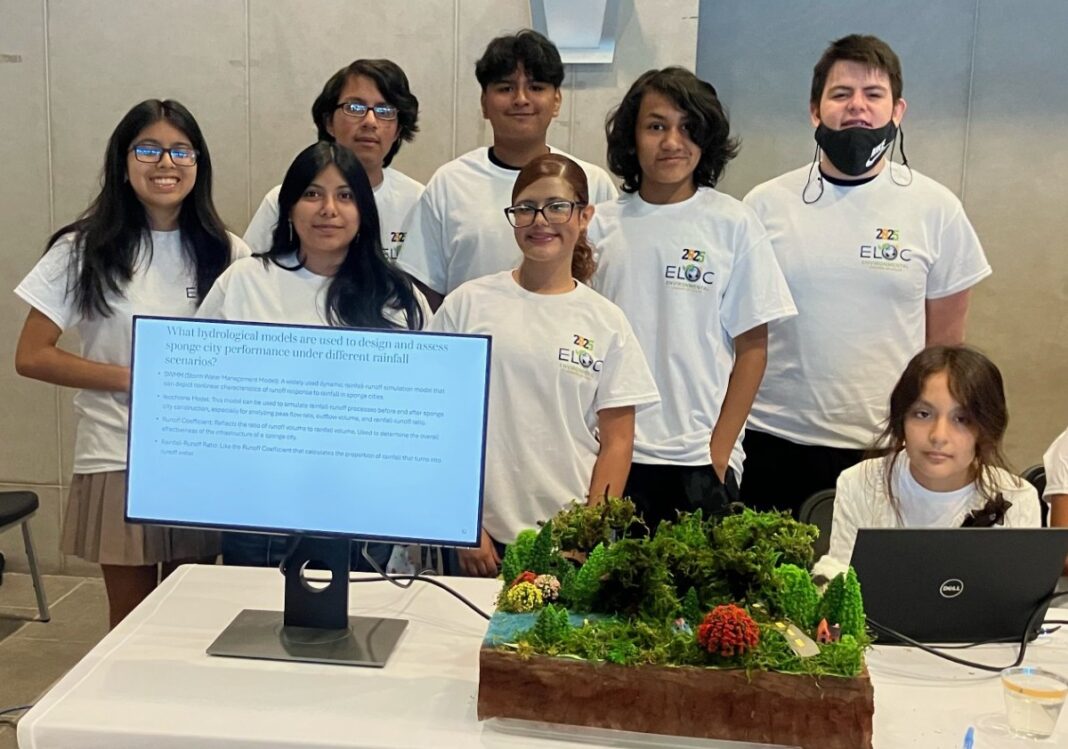

Members of Yonkers Team Sponge Cities, with their winning presentation
By Michael Gold
Planting sponge cities, hanging nylon mesh nets to collect rainwater and water vapor, and installing cool roofs were some of the innovative ideas several student teams presented to help reduce the effects of climate change, at the Environmental Leaders of Color (ELOC)’s 2025 summer energy and environmental program at the Yonkers Library, August 7th.
Each summer ELOC conducts a six-week STEM educational and leadership academy for teens in Yonkers, Mt. Vernon, New Rochelle and other Westchester locations, as part of the regular schedule of summer camp activities in these communities.
The winning team, called Rising Waters, all high school students from Yonkers, explained that sponge cities are a way to help lessen the effects of extreme flooding in urban areas, by planting trees, plants and grass on roadsides, sidewalks and even on walls and roofs.
The vegetation acts like a sponge by absorbing flood waters instead of letting rain pool and spread over impermeable surfaces such as asphalt and concrete roads and sidewalks. The team also recommended creating urban lakes in open areas to reduce the chances of flooding and installing permeable pavement to allow rainwater to percolate down into the ground.
“Some areas of Yonkers get a lot of flooding, “said Leonardo Resendiz, 15, a Yonkers resident and student at Fordham Prep in the Bronx, and part of the Rising Waters team.
“Buildings, asphalt, and concrete help worsen flooding. We’re trying to help reduce floods and save lives and help get government to save money,” Resendiz said.
“Sponge cities help to fight against not only floods, but they also help to fight against droughts, and heat waves, by cooling down what is known as the urban heat island effect, where urban cities or areas are experiencing different temperatures from neighboring rural areas. We can help cool down cities. We can also provide clean, healthy water to our communities,” Resendiz explained.
“Sponge cities can help stabilize water level conditions before, during and after the event of a flood,” said Luna Martinez, 14, a student at Barack Obama High School. “With absorbed water, they replenish ground water, to lower chances of drought and help in retaining water for future use,” she said.
The members of the team helped build the sponge city model out of moss, pipe cleaners and model clay.
“Flood mitigation and alleviation is very important to think about and to allocate the necessary funds to prevent present and future damages. It’s impressive to see and important that our youth now is helping to come up with solutions for the present and future,” said David Tubiolo, Westchester County District 14 legislator, representing parts of Yonkers and Mt. Vernon, who attended the ELOC showcase.
Yonkers, Mt. Vernon, New Rochelle and other communities in southern Westchester are all at risk from flooding due to climate change.
“The city of Yonkers has major risk from flooding. There are 6,320 properties in Yonkers at risk of flooding over the next 30 years. This represents 19 percent of all properties in Yonkers,” states First Street, a nonprofit organization that quantifies home and property climate risk.
“The city of Mt. Vernon has moderate risk from flooding. There are 2,033 properties in Mt. Vernon at risk of flooding over the next 30 years. This represents 18.7 percent of all properties in Mt. Vernon,” First Street’s website explains.
“The city of New Rochelle has major risk from flooding. There are 3,663 properties in New Rochelle at risk of flooding over the next 30 years. This represents 25.1 percent of all properties in New Rochelle,” First Street points out.
“Weather patterns are changing worldwide, including in the New York area,” wrote Dr. Diana Williams, Founder and Acting Executive Director of ELOC, in an email.
“Hurricanes are now reaching further into the North Atlantic, and flooding is becoming more severe and disruptive,” Williams wrote.
“While everyone is affected, low-income communities face the most significant and enduring risks, as limited resources hinder their ability to relocate, repair, or recover,” Williams explained.
“Now is the moment to assess the situation, develop strategic plans, and implement measures to better protect our communities. The 2025 class of the Environmental Leaders of Color summer students proposed practical mitigation strategies and solutions to address flooding in our region,” Williams pointed out.
“Increasing carbon is making the Earth warmer and heatwaves more extreme. The New York area is experiencing more hurricanes. People in New York need to be prepared,” said Dr. J. Marshall Shepherd, the ELOC showcase’s keynote speaker, director of the University of Georgia’s atmospheric sciences program, and a past president of the American Meteorological Society. He spoke via Zoom.
Other teams presenting their work included the Yonkers YMCA community garden, the Mt. Vernon Youth Bureau and the Cool Roofs team from the Bronx.
The Yonkers YMCA community garden proposed that homeowners install “fog collectors.” Fog collectors consist of nylon mesh that trap water vapor, fog and rain, with a tank placed below the mesh to collect the moisture the mesh attracts.
The Mt. Vernon team recommended creating a climate change tax refund program that offers taxpayers rebates for installing green roofs, LED lights, solar power, and efficient appliances, such as fans, to lower energy use.
The Bronx team encouraged property owners to install white or light-colored roofs, which help keep buildings cooler than dark asphalt or tar roofs, which absorb more heat.
Michael Gold is a Westchester-based reporter whose work has been published in The New York Daily News, The Albany Times-Union, The Hartford Courant, and other newspapers.