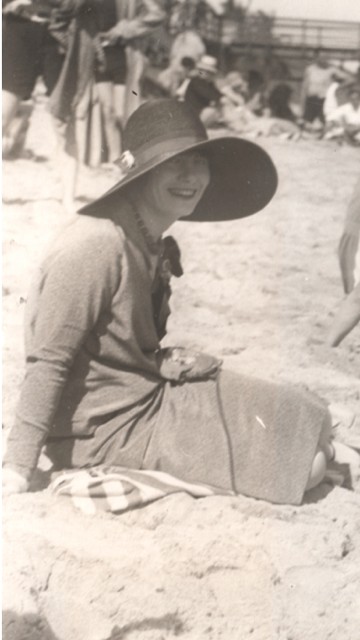
Margaret Thompson Schulze enjoying the sandy beach at The Breakers, Palm Beach, in 1927. Her family estate was on North Broadway by Odell Avenue. She later married Anthony Drexel Biddle, Jr.
By Mary Hoar, City of Yonkers Historian, President Emeritus Yonkers Historical Society, recipient of the 2004 Key to History, Yonkers Landmarks Preservation Board Member, Chair of Revolutionary Yonkers 250 and President Untermyer Performing Arts Council
Monday, July 28th
July 28, 1934: Two former Yonkers residents were caught in Austrian uprisings. Margaret Thompson Schulze Biddle, daughter of the late William Boyce Thompson was married to diplomat Anthony Drexel Biddle; the couple had rented a castle near Vienna for the summer.
Princess Chlodwig Holenlohe-Schillingsfurat, was the former Mrs. Gifford Cochran. Her late husband had been one of the owners of the Alexander Smith and Sons Carpet factory. She was living with the prince at his family estate in the Tyrol. Families of the two women had not heard from them since the revolt had started. Since the government-controlled communication lines, sending messages out of the country was difficult if not impossible.
Tuesday, July 29th
July 29, 1947: The Common Council directed City Manager Montgomery, Comptroller Kennedy, Tax Commissioner Lennox and Corporation Counsel Galloway to press for the reopening of the Empire Track. The State Racing Commission had advised the Council it felt the Yonkers track was outmoded and a “public disaster” might result. Mayor Frank stated he did not understand the commission’s statement about the possibility of a public disaster as more than 50,000 people had attended a Wilkie rally at the track. Councilmember Whalen recalled the largest racing event the Empire City Racing Association had an attendance of more than 34,000 people and stated that figure “…knocked down the argument it is inadequate. They’re giving us the runaround.”
Wednesday, July 30th
July 30, 1943: Employees at the Cameo Curtain plant at 45 John Street, with 90% of its work being war production, posted large signs in their workrooms. What did the signs read? “We will be closed the day of Hitler’s funeral.”
July 30, 1943: City Manager Walsh asked the Yonkers City Council offer the former Grassy Sprain Golf Club to New York State for the $2,000,000 post war training institute planned by the Board of Regents. The planned school could open with 2,000 students, with the capability of expanding to thousands more if needed. Walsh said Yonkers was an ideal site, as the largest industrial city in Westchester, had nearness to New York City, and the promise of being a great and growing industrial center.
Thursday, July 31st
July 31, 1943: The appearance of movie actress Carole Landis in front of a large crowd in Getty Square, resulted in Yonkers “Shangri-La” bond drive sales to increase by $32,000. Frank Alfidi of Yonkers, who had the pleasure of meeting Landis in North Africa while he was serving in the Navy, received special permission from his commanding officer to attend the ceremony in the Square; the two had a wonderful reunion!
July 31, 1945: Workers in the downtown offices and defense plants were surprised to learn they could not have a lunchtime libation; it was Primary Day. On the steamy days of summer, it was customary to accompany lunch with a tall frosty beer or cool cocktail! Some stayed at their midday haunt and just had lunch. A steady stream of men and women hailed a cab or jumped on a trolley to head across our southern border into the Bronx for the liquid refreshment of their choice. New York City, a first class city, did not open their polls until 3 pm!
Friday, August 1st
August 1, 1889: The annual Hudson River excursion of New York newsboys ended in a stone-throwing battle with Yonkers citizens and authorities.
Every summer, the young fellows had a day out on the water, sailing on the barge John Neilson towed by the tugboat Edmund J. Levy. Captain Sweatman had orders not to land, as in previous years the boys had wrecked parks and set a barn on fire. The boys were not told and soon became “mischievous” because they wanted more action than admiring the Palisades. The bigger boys were setting the pace, throwing belongings of smaller boys into the water. They threw an estimated 75 boat benches overboard, several water barrels, hatchets and flagpoles. The Captain, realizing the group was uncontrollable, decided to put into Yonkers to telegraph the police. When they arrived at the public dock about 2 pm, 800 boys jumped ashore. The boys began firing stones at the Yonkers people, injuring one of the officers on the face. When the officer was injured, the vessels pulled away from the dock. The boys on shore began throwing rocks at those still on the barge; the boys still on the Neilson returned fire until they were out of range. Only one of the boys was arrested and charged with disorderly conduct. When they reached the NY dock, the group left, growling at the Yonkers police.
Saturday, August 2nd
August 2, 1939: Gambling took place under the stars at Pelton Field… with police protection! An estimated 400 people took part in a bingo fundraiser run by the Eighth Ward Republican Club; they later usee the proceeds to buy Christmas baskets. At the time, Yonkers rented Pelton during the day to use as a playground, the only playground in Yonkers without swings, seesaws, or a sandbox.
August 2, 1941: St. John’s Church, Getty Square, announced they were launching a project to restore St. John’s Cemetery; the cemetery had been the resting place for Yonkers residents beginning in 1783, and had many Revolutionary War soldiers and patriots buried there.
Sunday, August 3rd
August 3, 1639: Three Weckquaskeck chiefs who owned Keskeskich– Fecquemeck, Rechgawae, and Packanniens– sold the tract of land called “Nepperhaem,” site of present-day Yonkers, to the West India Company.
August 3, 1954: Horn and Hardart opened its first waitress-service restaurant in Westchester in the new Cross County Shopping Center! The company’s first step of its plan to expand into New York suburbs, it had table seating for 300, and room at the counter for 60 people.
Questions or comments on this column? Email YonkersHistory1646@gmail.com.
For information on the Yonkers Historical Society, Sherwood House and upcoming events, please visit our website www.yonkershistoricalsociety.org, call 914-961-8940 or email info@yonkershistoricalsociety.org.